
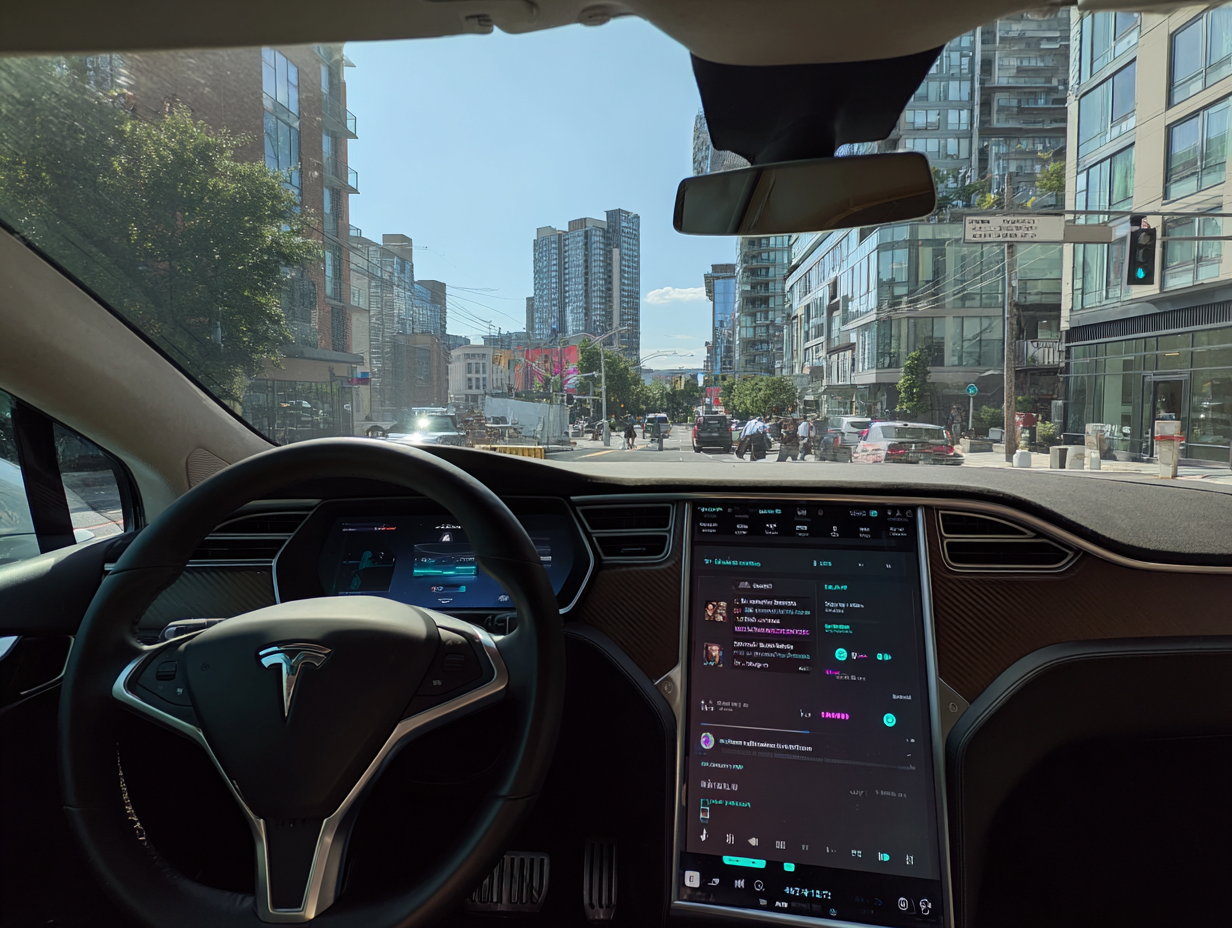
If you hop into your Tesla and say ‘Hi’ or ‘Hello’ after pressing the Voice Command button, there is a good chance it’ll reply with “Hello!” This is the newest and most interesting piece of news pointing us to the conclusion that a Tesla voice assistant is on the way.
Previously, if you tried this, it would simply return “Command not understood.” This is the first time the vehicle is responding and interacting with the user.
Experience It Yourself
You’ll need to have your vehicle language set to English. Once that’s done, you can use the voice command button on your steering wheel or yoke – for the Model 3 and Model Y, push the right wheel button, and for the Model S, Model X, and Cybertruck, press the button. Then go ahead and say Hi or Hello.
The Hello! response may even have regional differences. For a German Tesla owner, after setting his language to English, the response came back as “Hallo.” We’re interested to see what the responses may be in other regions, so let us know if you notice anything interesting.
We’ve tried a few other basic things, but it seems that, for now, the vehicle only replies to a simple greeting. Asking it what time it is or the $TSLA stock price doesn’t seem to do much yet – unless you’re in China with the updated Smart Assistant.
Server-Side Update
This update appears to be happening over Tesla’s voice system backend and doesn’t require the Holiday Update. Users who aren’t on the Holiday Update are reporting that they’re getting this new response as well.
We already know that Tesla interprets speech remotely, and the driver’s voice is not processed in the vehicle. Instead, the voice snippet is transmitted to Tesla’s servers, where Tesla processes it and sends a response back to the vehicle so that the vehicle can interpret it. This is unlikely to change with a smart assistant, as Elon Musk has already said that Grok will still process data server-side instead of on-device.
Many users recently also noticed significant improvements to voice commands, saying that the system understands them better and that responses now come back faster.
All of these things point to a new backend system for voice processing that Tesla is testing. It’s not unusual for a company to switch to a new backend process but keep the capabilities the same as the legacy system until it’s ready to roll out the new features. At that point, it’s simply a flip of a switch to allow the new capabilities.
The new smart assistant that was rolled out in China is mostly a backend change, with the in-vehicle experience largely remaining the same. The activation method (button press) and user interface remain the same. What changed is the response that comes back from the server, and the assistant gained a voice. The new voice we receive with a smart assistant could very well be the new voice users are experiencing in the navigation system in newer vehicles.
Vehicle Support – Intel?
When China received the Smart Assistant, it was locked to cars equipped with AMD Ryzen processors only. Shortly after its initial launch, it became available to older cars with Intel Atom processors as well.
However, we’re not sure whether it would apply to legacy Model S and Model X owners. A legacy vehicle owner had their vehicle report “Command not understood” when they tried the ’Hi’ voice command.
Grok for Tesla
Elon has previously mentioned that Tesla vehicles would receive Grok AI. Grok, as of yet, still doesn’t have live speech support like other LLM models such as OpenAI’s ChatGPT or Google’s Gemini. However, a major update to Grok just brought massively improved image generation via a new model called Aurora.
xAI has been hard at work improving Grok, and we’re sure that live speech support is on its way soon. Once that feature arrives on X, Tesla will likely be well-positioned to enable a Grok-powered smart assistant fleet-wide with a flick of a switch.