
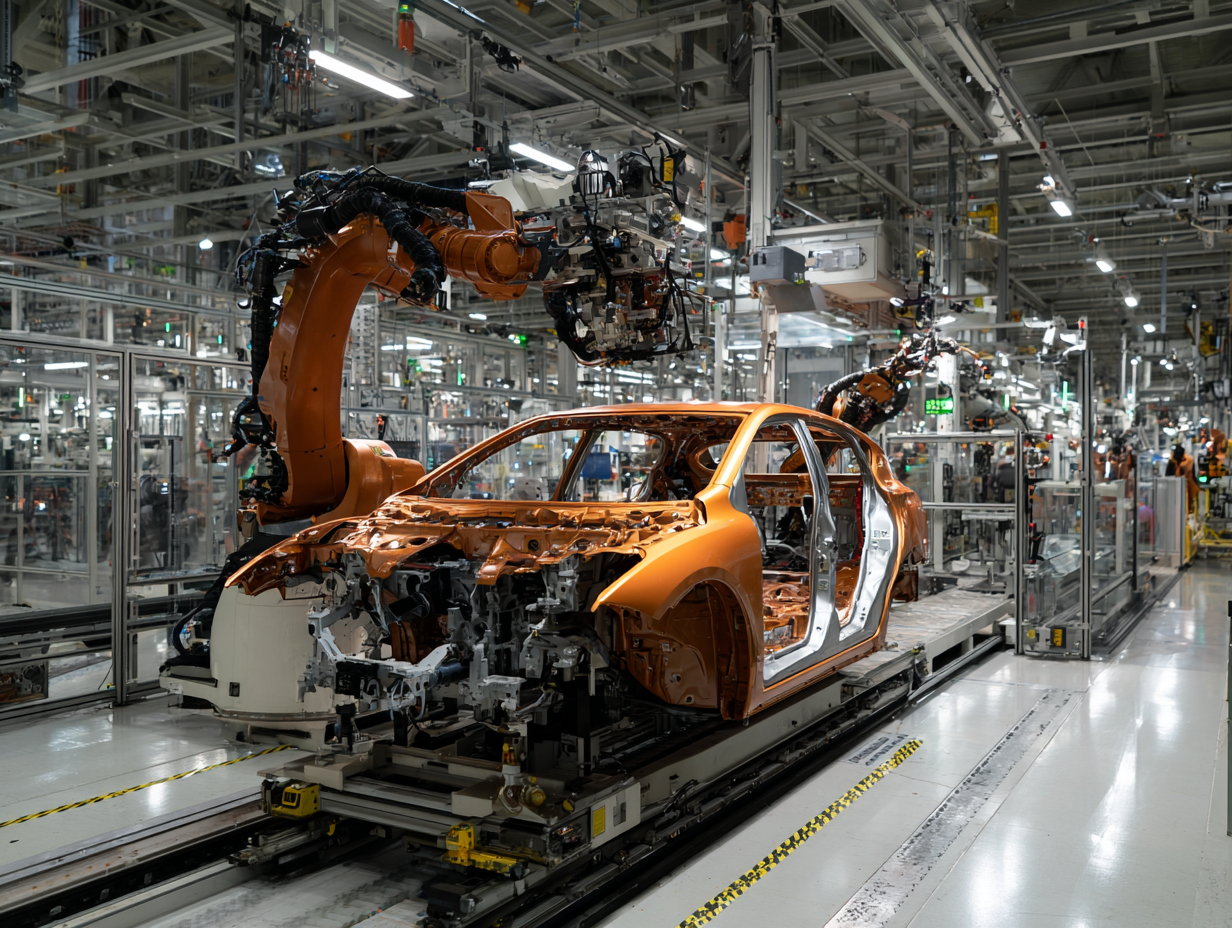
Nissan is making a radical shift in its manufacturing and marketing strategies in America. The Japanese automaker pulls the plug on its EV investment plan
Nissan announced that it is scrapping its EV strategy. The Japanese automaker was planning to produce electric vehicles at its Canton plant in Mississippi. Slowing EV demand in the U.S. market, the termination of the tax incentives for EVs, and the financial insecurities have led Nissan to pull the plug on its large-scale EV investment strategy.
Back in 2022, Nissan committed to turn its Canton, Mississippi, plant into a fully fledged electric vehicle manufacturing hub, based on a $500 million investment, with a target to sell no fewer than 200,000 electric Nissan and Infiniti units per year by 2028.
The automaker’s EV strategy in America was focused on accelerating electrification under the “Nissan Ambition 2030” long-term vision, aiming to pivot from its early pioneering status with the LEAF to a broader, more modern electric lineup, which included the Ariya crossover and other zero-tailpipe emission models.
Key pillars of this strategy included the launch of the Ariya crossover, significant investment in the U.S. manufacturing, and a target to have EVs make up over 40% of the automaker’s sales in America by 2030.
However, that plan gloriously failed. Late last year, Nissan announced that it would pause U.S. production of the Ariya electric crossover for the 2026 model year, effectively ending its run in the American market after 2025.
High production costs, which made the model struggle for profitability, import tariffs of approximately 15% on Japan-made vehicles, and a strategic pivot to focus resources on the new-generation LEAF led to the radical decision.
Nissan has also been struggling with financial issues. Nissan has even agreed to sell its global headquarters in Yokohama for 97 million yen, which translates to roughly $640 million based on a sale-and-leaseback agreement, which would allow the automaker to continue remaining in the building for 20 years.
In the meantime, Nissan has been implementing massive job cuts, slashing around 20,000 positions, which equals roughly 15% of its workforce by fiscal year 2027, to offset declining profits and high manufacturing costs.
The automaker is also closing down seven factories worldwide, including the facilities in Oppama and Shatai Shonan in Japan, its CIVAC plant in Mexico, and the manufacturing centers in India and Argentina. So shutting down its EV strategy was mostly a matter of “when” rather than a matter of “if.”
The Japanese carmaker confirmed plans to cancel all its programs to build electric cars in America, citing shifting market conditions and a revised global strategy. This means that Nissan will no longer invest $500 million at its plant in Mississippi, as reported by Automotive News. The Canton plant currently builds the Frontier pickup truck and the Altima sedan.
Chased away from its own plan by the decline in electric vehicle sales, Nissan is shifting back to hybrids and internal combustion engine-powered models, focusing on making them profitable.
Nissan has kicked off the development of a new body-on-frame architecture, set to underpin at least five new models, set to hit the market in the upcoming five years. The first of the lot will mark the comeback of the Xterra, which is expected to be officially unveiled sometime in 2028. A redesigned Frontier and a three-row SUV will follow suit.
To optimize production and reduce costs, Nissan is planning to include in its portfolio vehicles that will share up to 70% of the components.
It is a difficult time for EV manufacturers. Electric vehicle sales in the United States have taken a nosedive. Nissan’s EV sales in the United States suffered a sharp decline in the first quarter of 2026, with ARIYA and LEAF models seeing significant drops.
Only 56 Ariya units were delivered, despite Nissan ensuring customers that they will continue to benefit from assistance for their EV even though it is no longer in production. In the meantime, the LEAF deliveries dropped by a massive 71.2% to 668 units.
Just 56 Ariya units were delivered, while LEAF deliveries dropped by 71.2% to 668 units, and the tax credit elimination is just one of the reasons. The total Nissan Group Q1 2026 sales were 247,068 vehicles, down 7.5% year-over-year.
Nissan is far from being the only automaker pulling the handbrake on EV development. General Motors, Ford, and Honda have also either canceled or delayed their plans to roll out electric cars, shifting back to hybrids and ICEs.
Ford is killing its F-150 Lightning after just four model years and plans to develop more affordable EVs to move from the the $50,000 price range down to $30,000. The final F-150 Lightning is set to roll off the production line sometime this summer.
In the meantime, General Motors has EV development up in the air. The Silverado and GMC Sierra EVs are no longer coming in 2028 as originally planned. The auto giant is reportedly delaying the arrival of its next-generation electric trucks, after having invested $2.2 billion in its EV-dedicated Factory Zero in Detroit-Hamtramck.
Honda and Sony decided to scrap nearly its entire 0 lineup. The Afeela EV and three other electric cars are no longer coming. All of them were set to be built in America, at its Ohio EV Hub, as Honda was trying to offset the effect of tariffs imposed on imported goods.
Even Tesla is doing it. The final Model S and Model X have already rolled off the assembly line, as the EV maker will focus on autonomous driving technology, AI, and robotics. Tough times are coming for electric cars.